
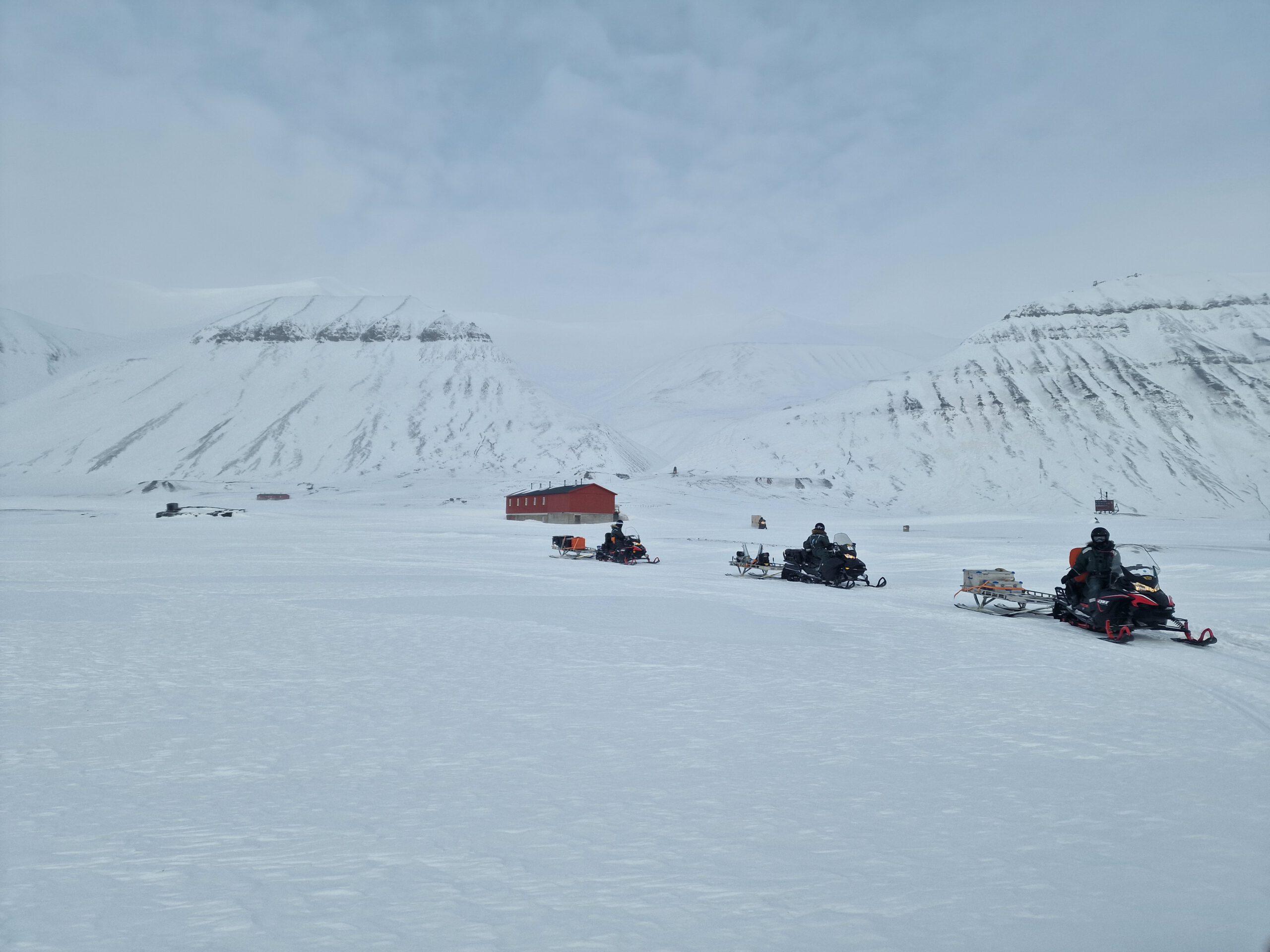
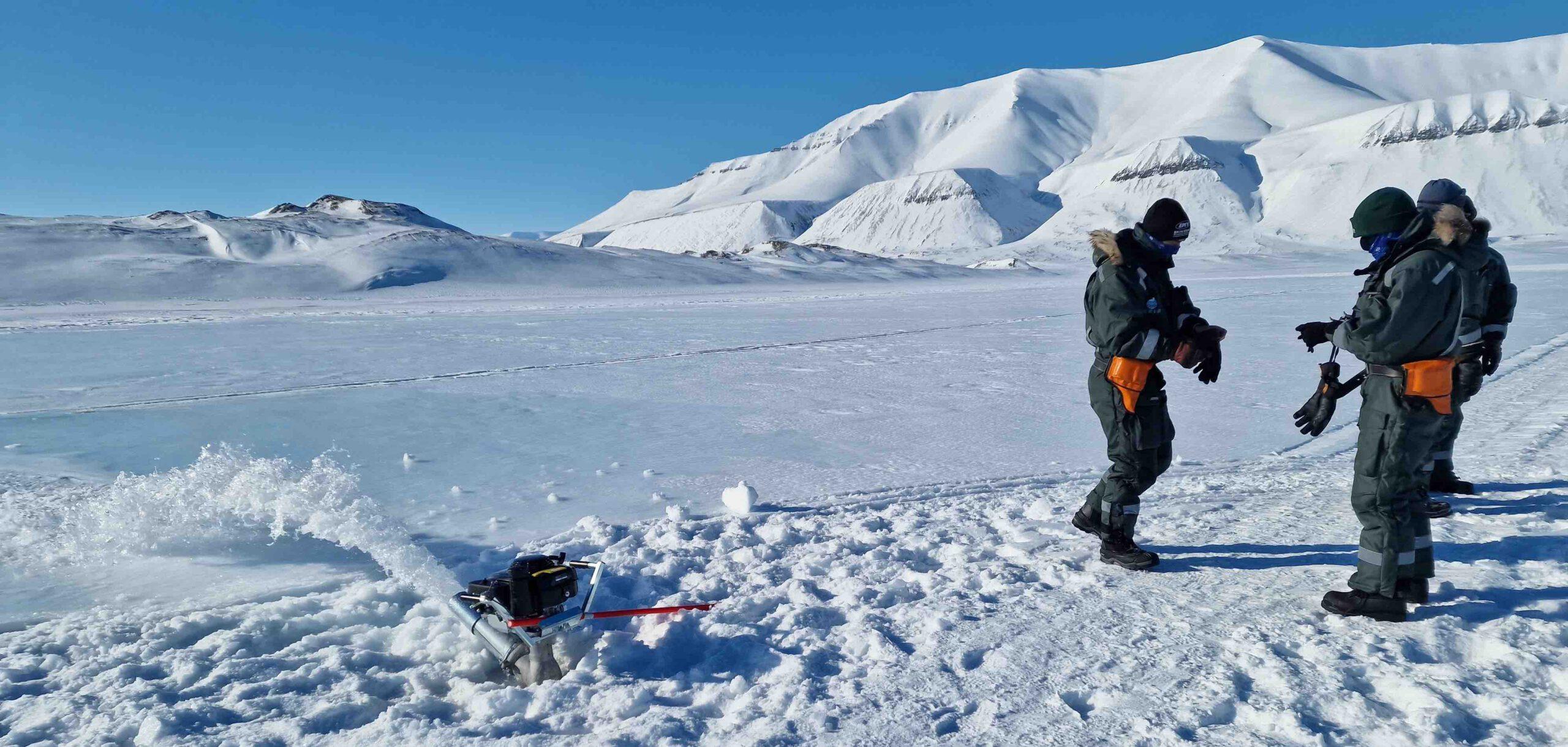
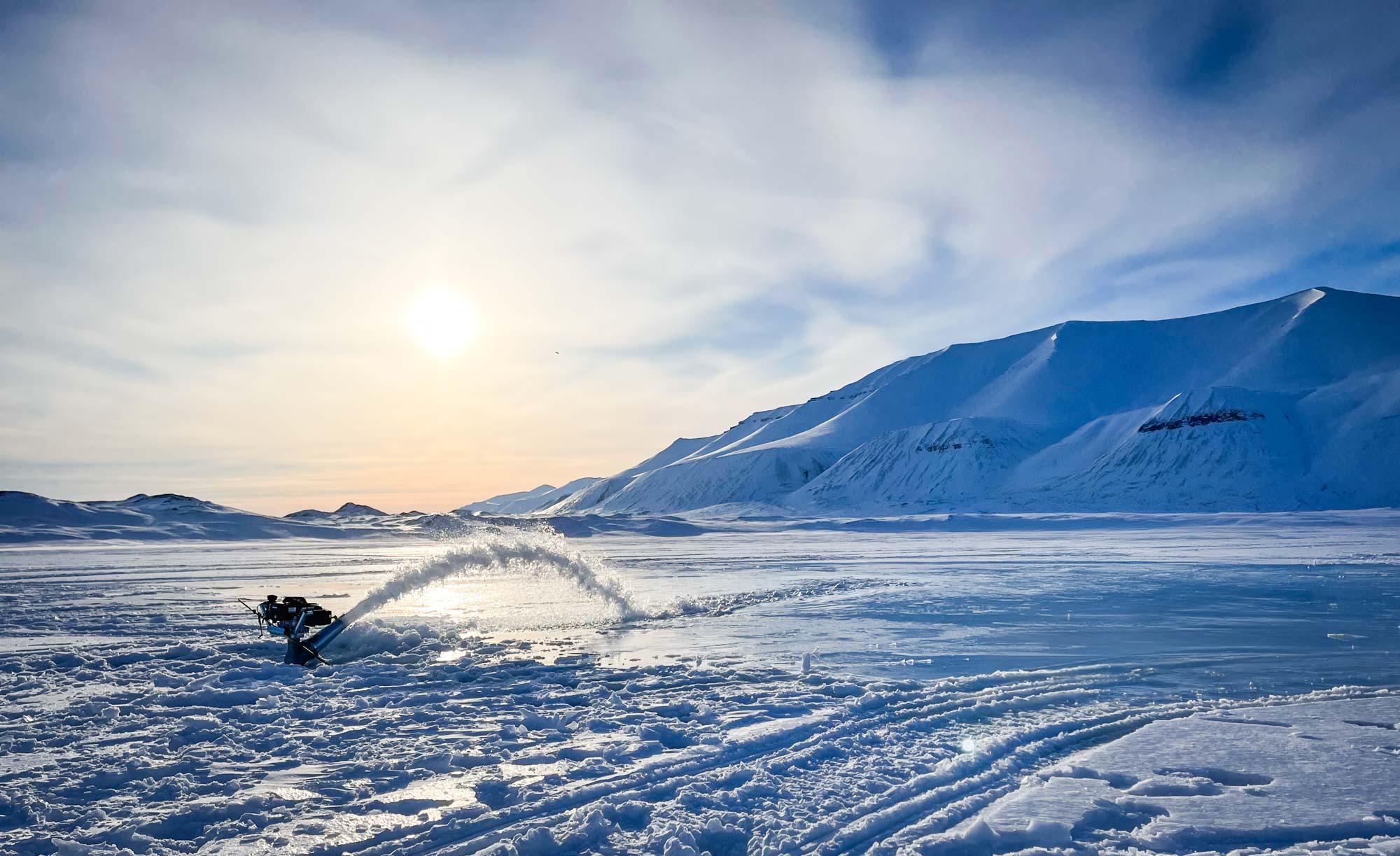
Our very first field test took place in Svalbard in April 2024. It was a joint project of Arctic Reflections with researchers from Delft University of Technology and UNIS (Svalbard). The tests took place at Vallunden Lagoon, connected to the Van Mijenfjorden via a narrow inlet, on Svalbard. Site A was our reference site, and next to this, we had three sites (B, C, and D) where we pumped water on top of the ice, using a standard ice-flooding pump with a flow rate of 210 m3 per hour. Snow on the ice cover mixed with seawater, creating the flooded layer that contributed to the overall thickened ice.
Our main objectives in the field tests were to:
- Validate that ice can be thickened substantially during a 1-week field test, observe the influence of snow and of salinity, observe how flooding affects the temperature profile of the ice.
- Validate that thickened ice lasts longer in summer than the reference ice and has a similar melting rate as the reference ice, and observe the influence of factors other than solar radiation on the melting process.
- Estimate how outgoing radiation is affected by flooding, both longwave (mainly during flooding) as well as shortwave (through albedo changes).
This field was featured in the Wall Street Journal and other news.
Our main findings
Ice thickness was increased by around one-quarter of the original ice, and the melting rate of the thickened ice was similar to the melting rate of the reference.
- By pumping for an average of only 4 hours on the different sites, we managed to flood the snow layer of around 20 cm, and thicken the ice by 24 cm in total.
- When the atmospheric temperatures increased, the ice gradually warmed, and then began to melt, and decreased in thickness.
- The melting period in Svalbard was identified as May 29th to June 19th, and at all sites, including the reference site, the melting rate was on average 4 cm per day.
- If the full ice melt would have been a linear process (which it clearly is not), then this would have resulted in the 24-cm thicker ice lasting 6 days longer.
- The total area covered on the 3 pumping sites was about 0.8 hectares, based on satellite images analysis.
Further research for following field tests
Overall, during this, our first field test, we recognised that the field tests that follow should be in different conditions: earlier in the winter, and across a larger area, are needed to fully demonstrate the effectiveness of ice thickening.
- More measurements throughout the ice season are needed to validate that the higher salinity in the flooded layer drains prior to, and does not accelerate, ice melting.
- Field tests earlier in the winter are needed for validating net ice growth.
- Tests with various pumping strategies and across a larger area are needed to exclude boundary effects and to ensure field test outcomes are robust against site and scale variabilities.
- Better understanding of the role the snow plays in spreading the water. This is crucial to understand scalability potential.
- A broader interplay of ice flooding with weather (clouds, precipitation) is currently unknown, as are environmental impacts, especially on microbial life in brine channels.
The Team
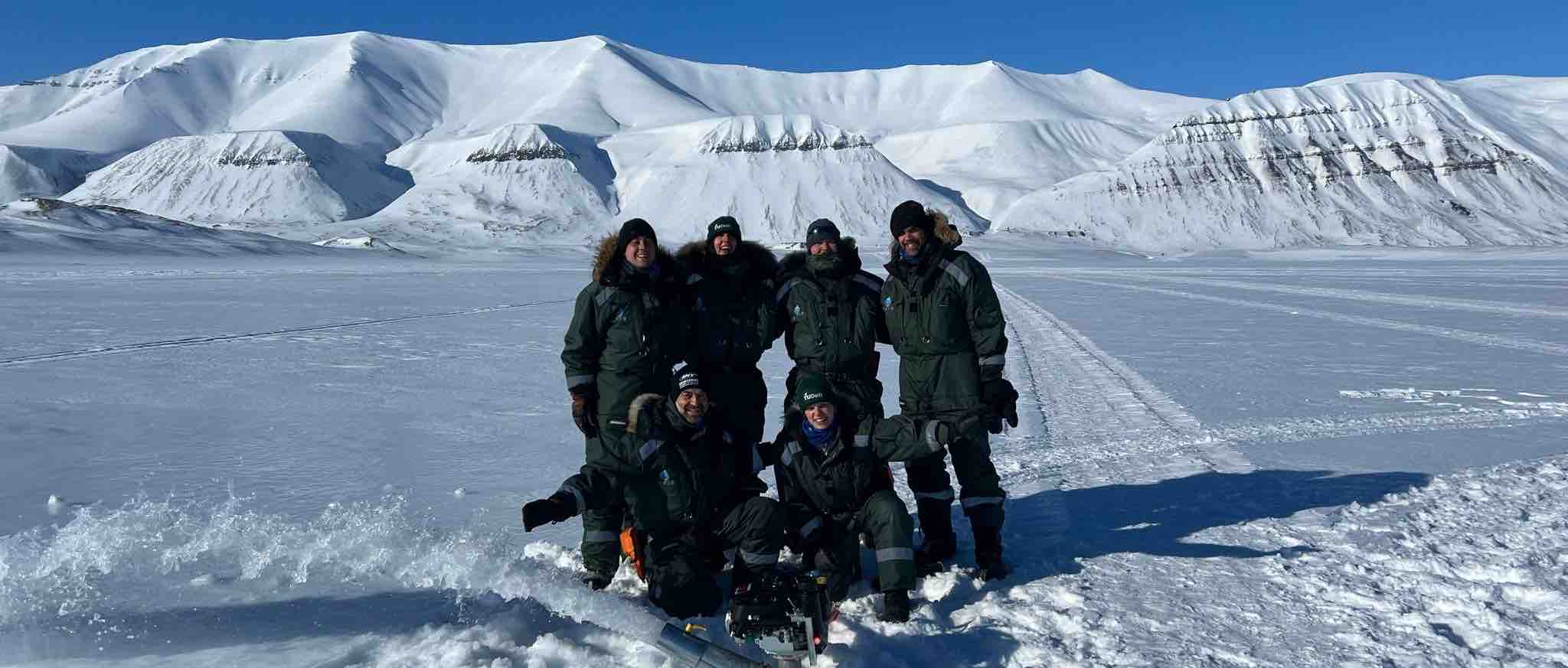
Fonger Ypma, Tom Meijeraan (Arctic Reflections), Tim Hammer, Hayo Hendrikse, Laura van Dijke (Delft University of Technology) and Aleksey Shestov (University Centre in Svalbard)
Reports from Svalbard
Arctic Reflections – Svalbard Field Test Research Summary Report (2024)
Arctic Reflections – Evaluation of Environmental Effects of field test operations in the Van Meijenfjord, Svalbard (2025)
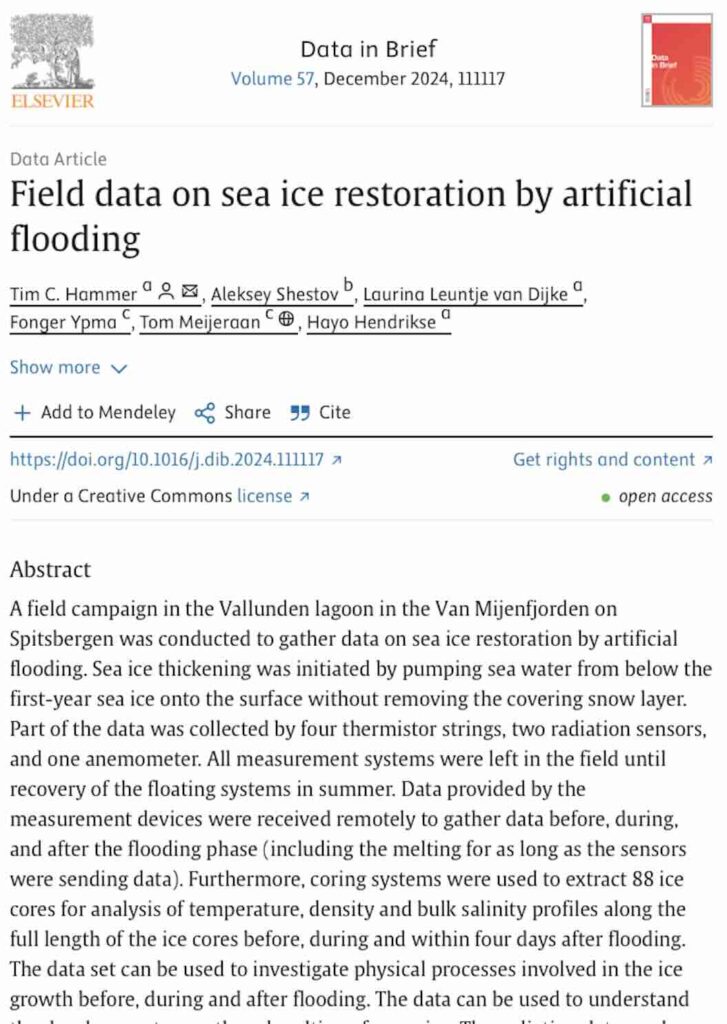
Tim C. Hammer, Aleksey Shestov, Laura van Dijke, Fonger Ypma, Tom Meijeraan, Hayo Hendrikse – Field data on sea ice restoration by artificial flooding (2024)
Updates from Svalbard
-
·
Now available: Research Summary Report of Svalbard fied test 2024
In April 2024 we conducted a field test to verify the impact potential of our ice thickening method. This was the first time this method was tried out in the Arctic in a comprehensive way, collecting a wealth of data and observations. We have summarized our findings in a Research Summary Report. This can be seen as…
-
·
Our field test at Svalbard with UNIS and Delft University
Arrival Mid-April, we arrived in Svalbard, for our field test at the Vallunden lake near Svea, an old coal mine. This is part of our collaboration with UNIS (The University Centre in Svalbard) and Delft University. The joint team consisted of Aleksey Shestov of UNIS, Hayo Hendrikse, Tim Hammer, Laura van Dijke of Delft University,…