

Our advisors play a crucial role in ensuring the success of our endeavour. This week we talk to our advisor Dr. Geoffrey (Geoff) Evatt a Senior Lecturer in Applied Mathematics at the University of Manchester. Geoff has specialised in glaciology for almost 20 years, and we ask him how he became involved with Arctic Reflections and how he balances rigorous scientific research with the need for urgent climate action.
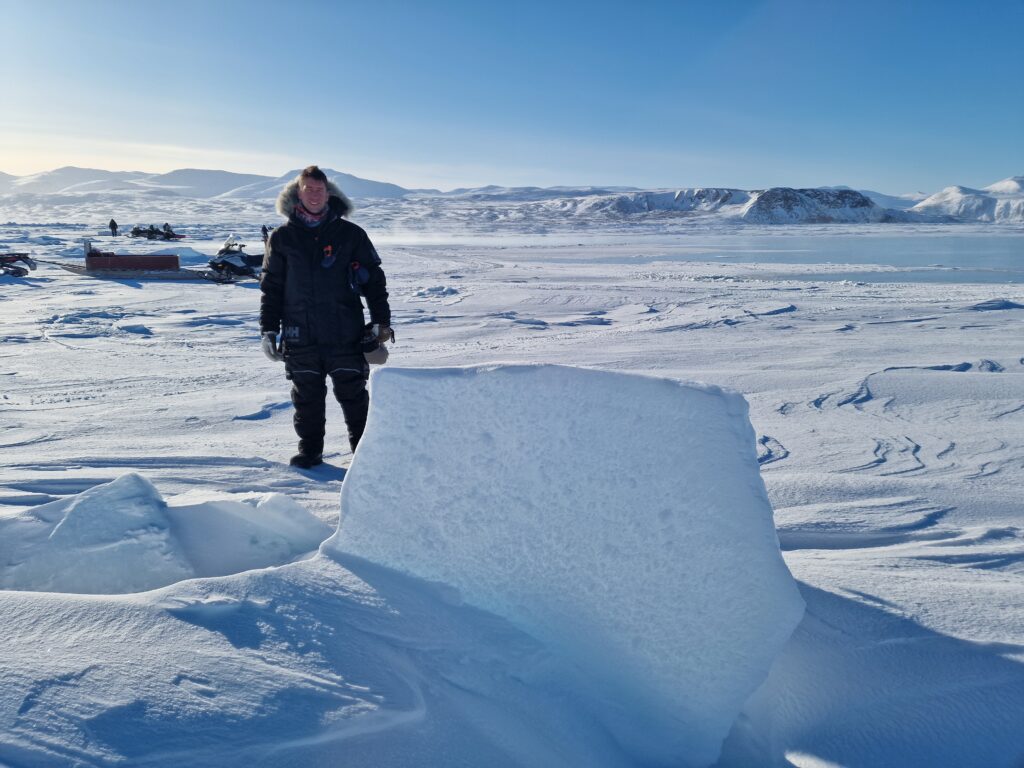
“Fonger and I were in the same college at Oxford,” explains Geoff. They stayed in touch, and when Fonger Ypma founded Arctic Reflections, the two spoke weekly, working closely on the ARIA funding application. Geoff was crucial in drafting the input for the ice arch project, now part of the ARIA-funded consortium, and he serves as deputy Principal Investigator on RASI (Re-thickening Arctic sea ice), the project Arctic Reflections is a part of.
Critical not timely
As part of this perhaps timely research, we are investigating the possibility of strengthening the weakening ice arch in the Nares Strait, to prevent Arctic ice from travelling out of the Arctic.
“I would call it critical rather than timely,” suggests Geoff. “This research should have started 20 to 30 years ago. The idea of blocking the channels through which Arctic ice is exported isn’t new. But doing it in a way that works with nature – reinforcing what ice arches do naturally but are weakened by warming – is difficult to model and the implications are hard to quantify. So yes, it’s critical to conduct this research now, while there’s a window of opportunity.”
“This window is narrowing for Arctic sea ice loss too,” he adds. According to Geoff, we are warming at the upper end of all climate scenarios. Most future scenarios don’t account for tipping points, so there’s a real risk of runaway processes. “If we’re going to have any hope of an intervention working, we need to act now. The longer we wait, the closer we get to a point where it’s simply too warm for it to be effective,” he adds.
“This research should have started 20 to 30 years ago”
When a plan meets reality
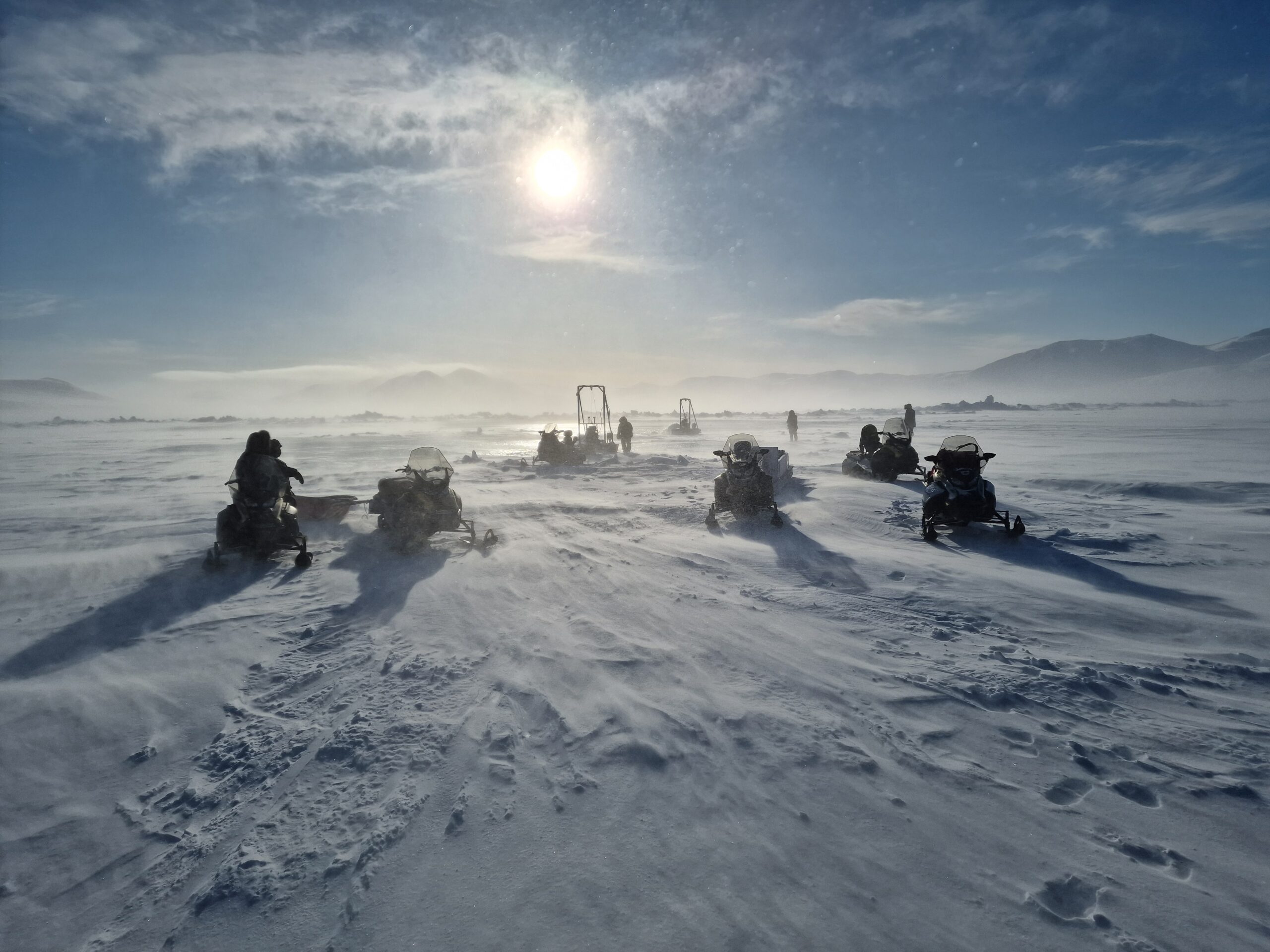
Geoff was also part of the field test earlier this year in Qikiqtarjuaq. The field work, he says, tells you things climate models cannot. “The physical reality of it,” he explains, is the main takeaway. “You can design an idealised experiment on paper, but it’s helpful to see how the people and equipment work in the extreme cold. It’s hard work. And that’s the reality.” He emphasises this point with the boxer Mike Tyson’s famous quote: “Everyone’s got a plan until they get punched in the mouth.”
The community’s involvement was a valuable part of the field tests too, and it’s something he’d like to see more of in theoretical work as well. “Community input is irreplaceable – it’s their land, and there’s no substitute for working alongside people who know it.” The core result, he observed during this field test, is that the plan survived its contact with reality. “You can pump water onto ice and create a thicker layer. That’s significant. And over three field tests the equipment has improved, the area covered has grown, and you can see how it could be scaled up.”
“Community input is irreplaceable – it’s their land, and there’s no substitute for working alongside people who know it.”
A narrowing window of time
In addition to teaching at university and participating in our field tests, Geoff is busy with rewilding and planting trees near his home, with nearly 40,000 trees planted – he thinks it’s important to do whatever we can. When asked how he balances the need for urgent climate action with the time needed for rigorous research, he replies that academia isn’t really designed to move quickly. There are areas of academia that have translated research into action really well, notably translational medicine, like the COVID vaccine. But glaciology has never had to move at any pace other than glacial.
That said, Geoff doesn’t think the solutions to the climate crisis are going to come from any one field. For him, they will emerge from somewhere in the middle, where economics, community knowledge, government policy, ecology, mathematics, polar science, history and all of it intersect. He concludes: “Everyone’s shouting from different directions, so the solution is going to have to be a compromise. All these different aspects and voices have got to be involved – the window is closing.”